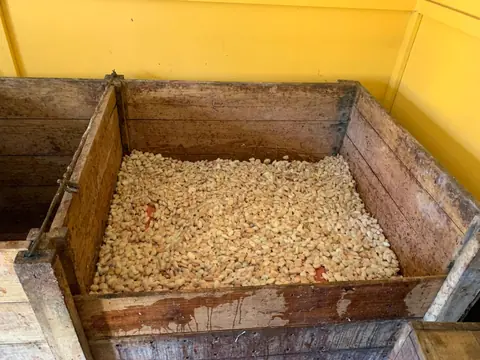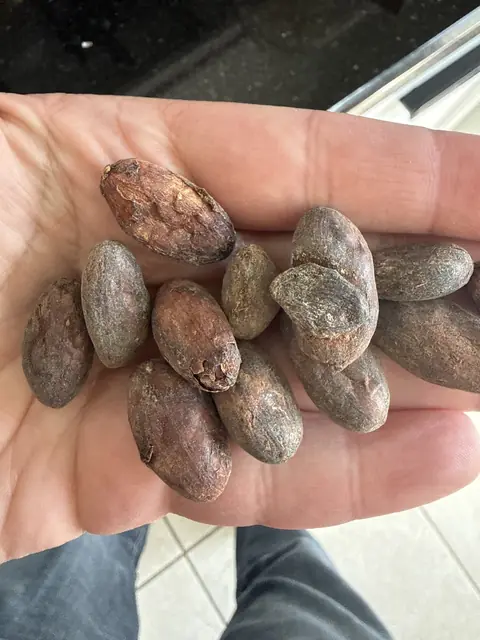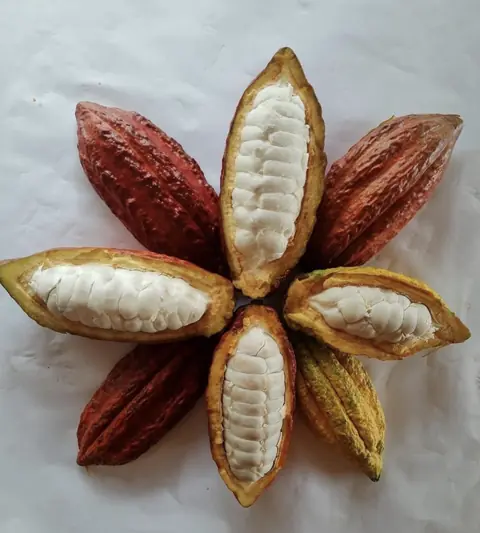
The cacao cut test, explained (with real lot data)
A cacao cut test means slicing a counted sample of dried beans lengthwise and sorting the halves by colour and structure. It is the quickest honest look at how a lot was fermented, dried and stored.

- A cut test classifies 100 or 300 dried beans, cut lengthwise, as fully fermented, partially fermented, violet, slaty, mouldy, insect-damaged, germinated or flat.
- Brown, fissured beans mean good fermentation. Violet and slaty beans mean astringency and bitterness. Mould is a defect no roast can fix.
- Read it alongside moisture and bean index. Together they tell you about flavour, yield and storage risk.
- Worked example: Macondo's report No. 0250 shows 94% fully fermented beans, 0% mould and slaty, 7.1% moisture, and Grade 1 under ISO 2451:2017.
Before you roast a single bean, a lot has already been decided. Harvest, fermentation, drying and storage are done, and most of what they did to the flavour is visible inside the bean. The cut test is how you look.
It costs a knife and twenty minutes. Every serious buyer of cocoa beans uses it, from commodity graders to two-person bean-to-bar shops. Here is how to read one.
What a cut test is
A cut test, or cocoa bean cut test, is a visual examination of the inside of dried beans. A counted sample is cut lengthwise through the middle, so that the largest possible surface of both cotyledons is exposed. Each bean is then placed in one category based on its colour, its internal structure and any visible defects.
The result is a set of percentages. They don't measure flavour directly, but they are a reliable proxy for the things that create or destroy it. The method is described in ISO 1114, and the grading that uses it is set out in ISO 2451 and, in Colombia, in NTC 1252.
How a cut test is done
- Sample. Draw beans from several points in the lot so the sample represents the whole. Formal grading under ISO 2451 is based on 300 beans; a quick check often uses 100.
- Cut. Slice each bean lengthwise through the middle, with a sharp blade or a cut-test board (a guillotine that holds 50 beans at a time, like the one in the photo above).
- Look. Examine both halves in good, even daylight.
- Classify. Put each bean in one category only. When a bean has more than one defect, standards count it once, under the most serious one.
- Count. Convert the counts to percentages and record them.
The categories, and what they tell a maker
| Category | What you see | What it tells you |
|---|---|---|
| Fully fermented | Brown cotyledons, open and fissured, often a little crumbly | Fermentation went to completion. Flavour precursors formed; astringency fell. This is what you want most of. |
| Partially fermented | Part brown, part purple; fissures less developed | Fermentation was close but uneven. In small numbers, normal. |
| Violet (under-fermented) | Mostly purple and compact | Fermentation was short, or the mass wasn't turned enough. Adds astringency and bitterness, mutes chocolate flavour. |
| Slaty | Grey to black, dense, cheese-like texture | The bean was barely fermented, if at all. Very astringent and flat. A serious defect. |
| Mouldy | Visible mould inside the bean | Slow drying, rewetting or damp storage. Musty off-flavours that roasting cannot remove, and a food-safety concern. |
| Insect-damaged | Holes, tunnels, insects or their traces inside | Usually a storage or transport problem. Opens the bean to mould and contamination. |
| Germinated | Shell pierced or split by the growing germ | Overripe pods, or delays before fermentation. The opening invites mould and insects. |
| Flat | So thin there is no cotyledon to cut | Nothing to roast. A yield loss, and a sign of poor pods. |
| Over-fermented | Very dark brown, sometimes with a hammy or putrid smell | Fermentation ran too long. Off-flavours that no profile can fix. |
One caution on colour. The purple comes from pigments in the bean, and fermentation breaks them down. Fresh Trinitario and Forastero-type beans are deep purple inside, which is why a violet bean in a cut test is a bean that never finished changing. Genotypes with pale, Criollo-type seeds don't follow the same colour logic, so read them with care.
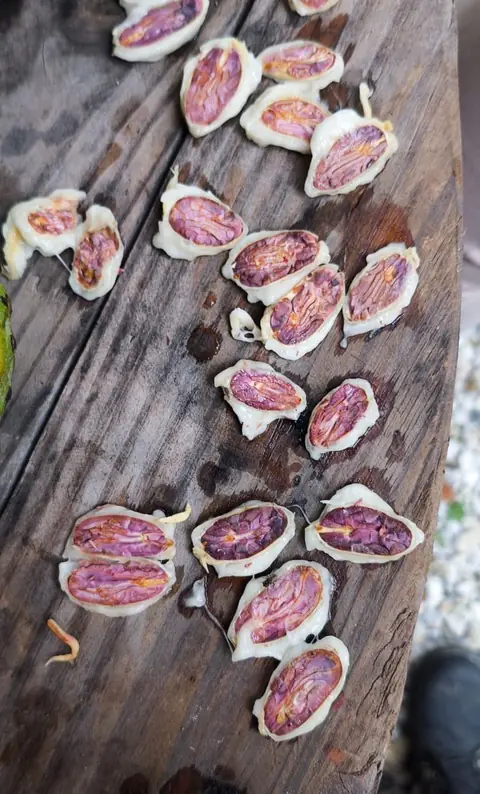
Those are fresh beans, straight from the pod, before fermentation. Five or six days in the box and several more drying are what turn that purple into the brown of a well-fermented bean. For the whole sequence, see from cacao harvest to chocolate.
Bean index, bean count and moisture
A cut test report usually comes with two more numbers.
Bean index is the average weight of one dry bean, in grams. Bean count is the same thing turned around: the number of beans in 100 g. Bigger beans generally mean a better ratio of nib to shell and more even roasting, and grading standards classify lots by bean count. A bean index of 1.8 g works out to roughly 55 beans per 100 g.
Moisture is about safety and storage. Beans that are too wet invite mould; beans that are over-dried can become brittle and break. In Colombia, NTC 1252 sets a maximum of 7.0% for its premium grade and 7.5% for the others.
How to read a cut test against a grade standard
ISO 2451:2017 is the international specification for cocoa beans. It defines each defect, requires the cut test, and sets grade limits mainly on the share of mouldy, slaty and insect-damaged, germinated or flat beans, with Grade I the strictest. It also classifies beans by size.
Colombia's national standard, NTC 1252 from ICONTEC, uses a grade table of its own. As given in our reference source, it reads:
| NTC 1252 parameter | Premium / Special | Standard | Common (Corriente) |
|---|---|---|---|
| Well-fermented beans (min per 100) | 70 | 65 | 55 |
| Insufficiently fermented (max per 100) | 30 | 35 | 45 |
| Maximum moisture | 7.0% | 7.5% | 7.5% |
| Internal mould (max per 100) | 1 | 3 | 5 |
| Insect-damaged / germinated (max per 100) | 1 | 2 | 3 |
| Slate / slaty beans (max per 100) | 1 | 3 | 5 |
| Foreign matter (max) | 0% | 0.3% | 0.5% |
Notice how forgiving the fermentation lines are compared with the defect lines. A lot can be 30% under-fermented and still sit in the top Colombian grade, but it can carry only one mouldy bean in a hundred. Grade standards protect against defects. Flavour is your job, which is why fine-flavour makers usually look for fully fermented figures well above the minimum.
How to run your own cut test on a sample
You don't need a lab. You need a sample and an hour.
- Pour the sample out and mix it. Take beans from all over the pile, not just the top.
- Count 100 beans and weigh them together. Divide by 100 for your bean index.
- Set aside anything flat, broken or clumped, and note it.
- Cut each bean lengthwise with a sharp knife or a cut-test board. Lay the halves out in rows of ten so counting is easy.
- Classify each bean under daylight. If in doubt between two categories, choose the worse one.
- Smell the cut beans. Vinegar, smoke, must or ham tell you things colour can't.
- Photograph the board and write the percentages down. Then compare them with the supplier's report.
If your numbers and the report broadly agree, that is a good sign about the supplier as well as the beans. If they don't, ask why. Our guide on how to choose a cacao bean supplier covers what else to check.
Worked example: Macondo, report No. 0250
Here is a real report: the physical examination of our Macondo lot, harvested October to November 2025 at Finca Macondo in Quimbaya, Quindío. Report No. 0250 is dated 29 December 2025; the analyst was Edwin Calderón Agudelo.
| Fully fermented | 94% |
|---|---|
| Partially fermented | 2% |
| Violet | 4% |
| Mouldy | 0% |
| Slaty | 0% |
| Insect-damaged | 0% |
| Germinated | 0% |
| Over-fermented | 0% |
| Moisture | 7.1% |
| Bean index | 1.8 g |
| Whole beans | 99.98% |
| pH (nib) | 4.4 |
| Grade | Grade 1, ISO 2451:2017 |
What those numbers mean
Fermentation. 94 of every 100 beans are fully fermented, and only 6 are partially fermented or violet. That is far above the 70 per 100 in the NTC 1252 premium column, and it means the flavour precursors had a chance to form in almost every bean.
Defects. Zero mould, slaty, insect-damaged, germinated or over-fermented beans. This is the part of the report that matters most for safety and for off-flavours, and it is clean.
Moisture. 7.1% sits inside the 7.5% of NTC 1252's standard and common columns, and a tenth of a point above the 7.0% its premium column sets. The report grades the lot under ISO 2451, where it is Grade 1. Plan on storing the beans cool and dry, as you would any lot.
Size and integrity. A 1.8 g bean index is about 55 beans per 100 g, a good, generous size. 99.98% whole beans means almost no breakage in the bag.
pH. A nib pH of 4.4 tells you there is acidity to work with. On its own, pH can't say whether that acidity is pleasant. The independent sensory panel that scored Macondo 88/100 described it as citric: mandarin and neroli. The tested roast profile for this lot treats that bright note as varietal, not something to roast out.
Put together: a well-fermented, defect-free lot of large, intact beans, with lively acidity. That is what the numbers say. Your own cut test on a sample is how you check them.
Frequently asked questions
What is a cacao cut test?
A cut test is a quality check in which a counted sample of dried cocoa beans, usually 100 or 300, is cut lengthwise and each bean is classified by the colour and structure of its cut surface. The percentages show how well the lot was fermented and whether it has defects such as mould, slaty beans or insect damage.
What does a good cut test look like?
Most beans are brown and fissured, violet and partially fermented beans are a small minority, and mould, slaty, insect-damaged and germinated beans are at or near zero. The NTC 1252 premium grade, for example, asks for at least 70 well-fermented beans per 100 and no more than 1 mouldy bean per 100.
Do violet beans mean a lot is bad?
Not on their own. Violet beans are under-fermented and add astringency and bitterness, so the question is how many there are. A few percent is normal in fine-flavour lots; a high share points to short fermentation or poor turning and will show in the chocolate.
How many beans should I cut when testing a sample?
Cut 100 beans for a quick read, and 300 if you want a figure comparable with formal grading, which under ISO 2451 is based on 300 beans. Draw them from several points in the bag so the sample represents the lot.
- ISO 2451:2017. Cocoa beans: Specification and quality requirements. International Organization for Standardization.
- ISO 1114:1977. Cocoa beans: Cut test. International Organization for Standardization.
- NTC 1252 (2021). Cacao en grano: especificaciones y requisitos de calidad. ICONTEC.
- Jaimes Suárez, Y.Y. et al. (2022). Modelo productivo para el cultivo de cacao (Theobroma cacao L.) en el departamento de Santander (2a ed.). AGROSAVIA. doi:10.21930/agrosavia.model.7405538
- Physical examination report No. 0250, Macondo lot (29 December 2025). Analyst: Edwin Calderón Agudelo.
- Sensory evaluation of Macondo, Chocolates del Eje / Cacao Trueques (25 January 2026).