Colombian cacao regions: where the country's fine-flavor beans grow
Colombia grows cacao in 27 departments, but production is concentrated: Santander alone produced about 41% of the national crop in 2021. Here is how the main regions differ, and how much of that difference reaches the bar.

- Cacao from Colombia comes from 27 departments and roughly 65,000 farming families. Santander, Arauca and Antioquia produced over 60% of the 2021 crop.
- The main subregions are the Santander mountains, Magdalena Medio, the Llanos foothills (Arauca, Casanare, Meta), the inter-Andean valleys (Tolima, Huila), and the Pacific and Amazon lowlands.
- Region matters, but genetics and post-harvest matter more. Terroir's share of flavor is real and still debated.
- A region name on a bag is a starting point. Ask for the clones, the fermentation protocol and the lot's cut test.
Cacao from Colombia: the national picture
Colombia's cacao sector covered about 194,000 hectares in 2021 and supported roughly 65,000 families. Production reached 69,101 tonnes of dry beans that year, up 48% on 2013.
The crop grows best below about 1,000 m, with mean temperatures of 24–28 °C and 1,800–2,600 mm of well-distributed rain a year. Colombia's three Andean ranges create many places that fit, at very different altitudes and rainfall patterns. That is why the country's cacao map is a patchwork rather than one belt.
Most production sits in a handful of departments:
| Department | Production 2021 (t) | Share of production | Area 2020 (ha) |
|---|---|---|---|
| Santander | 28,107 | 40.7% | 59,711 |
| Arauca | 7,896 | 11.4% | 14,367 |
| Antioquia | 6,664 | 9.6% | 16,474 |
| Tolima | 4,031 | 5.8% | 12,114 |
| Huila | 3,510 | 5.1% | 12,300 |
| Nariño | 3,483 | 5.0% | 15,149 |
| Other departments | 15,410 | 22.3% | 64,513 |
| Total | 69,101 | 100% | — |
Source: MinAgricultura, Cadena de cacao, Cifras Sectoriales (2021); Fedecacao, Economía Nacional (2022). Shares are calculated from the tonnage shown. Area figures are for 2020; the area total is omitted because the compiled rows do not sum to the published national figure.
Santander cacao: the Montaña Santandereana
The mountains of Santander are Colombia's main cacao zone by area and by production. The core municipalities are San Vicente de Chucurí, El Carmen de Chucurí, Rionegro, Landázuri and Cimitarra.
Conditions, as described by AGROSAVIA:
- Altitude 400–1,000 m above sea level.
- Mean temperature 23–30 °C.
- Bimodal rainfall of 1,600–2,500 mm a year, which gives two harvest cycles.
- Steep slopes, from 25% to 75%, and well-drained soils of low to moderate fertility.
This is also where Colombian cacao science is concentrated. AGROSAVIA's La Suiza research center in Rionegro holds the national germplasm bank, and the TCS clone series was developed and validated mainly under Santander conditions. Fedecacao's FSV clones are named for San Vicente de Chucurí and its FLE clones for Lebrija. Our guide to Colombian cacao varieties explains those clone families.
For a maker, Santander means the deepest pool of documented, clonal cacao in the country, and two harvests a year.
Magdalena Medio
The middle Magdalena valley, spanning parts of Santander, Bolívar, Antioquia and Boyacá, is the second most important cacao zone. It is lower and hotter than the Santander mountains: 100–400 m above sea level, 25–32 °C, with more pronounced dry seasons.
AGROSAVIA validated several TCS clones for this subregion, notably TCS 13 and TCS 19. Heat and a marked dry season also change the conditions in which farms ferment and dry their beans.
Piedemonte Llanero: Arauca, Casanare and Meta
Where the Eastern Cordillera drops into the Llanos, the eastern plains, lies a large and growing cacao area across Arauca, Casanare and Meta. Arauca alone produced 11.4% of the national crop in 2021, second only to Santander.
Fedecacao selected several of its clones here: FEAR 5 from Arauquita, FTA 2 from Tame, and FSA 12 and FSA 13 from Saravena, all in Arauca.
Meta is one of the origins on SelvaCoa's waitlist. It is not for sale yet.
The Pacific and Amazon lowlands
Nariño, Putumayo, Caquetá and parts of the Pacific coast contribute a significant share of national production. In Nariño, much of the cacao is grown on the Pacific side, around Tumaco. In many of these territories cacao is planted as a substitute for illicit crops, and since the 2016 peace agreement it has become part of rural development in former conflict areas.
Conditions are demanding: more than 3,000 mm of rain a year, high humidity and high disease pressure. That makes careful post-harvest handling especially important.
The Amazon departments matter for another reason. A 2018 collecting expedition by AGROSAVIA and the Universidad de los Andes found significant wild Theobroma diversity in Caquetá and Putumayo. That material is not yet part of commercial breeding, but it is a genetic reserve for future Colombian clones.
Huila and the inter-Andean valleys
Huila sits in the upper Magdalena valley, south of Tolima. Together the two departments produced about 11% of the 2021 crop: 4,031 tonnes from Tolima and 3,510 from Huila. AGROSAVIA's Nataima research center, in Espinal, Tolima, serves this inter-Andean valley region, and the institute publishes cultivation manuals specifically for Huila.
The history of cacao in Colombia covers how the crop spread through these valleys and the rest of the country.

Huila is on SelvaCoa's waitlist. It is not for sale yet.
Sierra Nevada de Santa Marta
The Sierra Nevada de Santa Marta is a mountain massif rising from the Caribbean coast in northern Colombia, separate from the Andes. Cacao has deep roots in Colombia's Caribbean region: archaeological evidence shows it was used there long before the colonial period.
The research sources we rely on do not publish altitude, rainfall or temperature figures for Sierra Nevada cacao, so we will not give any. Because cacao generally grows below about 1,000 m, Sierra Nevada cacao comes from the lower elevations of the massif.

Our Sierra Nevada origin is Canaán, a TCS-01 farm in Sierra Morena, Magdalena, that took first place in the 2025 Grano de Oro national contest. It is arriving soon: join the free sample waitlist. Our guide to Sierra Nevada cacao and TCS 01 goes deeper.
Quindío cacao and the coffee region
The coffee region of Caldas, Risaralda and Quindío is better known for coffee than cacao, and Quindío does not appear among the leading departments in the table. But the lower, warmer fringe of the coffee zone, which Colombian researchers call the zona cafetera marginal baja, grows cacao too, and its commercial clones have been studied in their own right.
This is where our one origin comes from. Finca Macondo is in Vereda El Laurel, Quimbaya, Quindío. The lot is a blend of the Fedecacao clones FSV 41 and FEAR 5, harvested in October and November 2025.
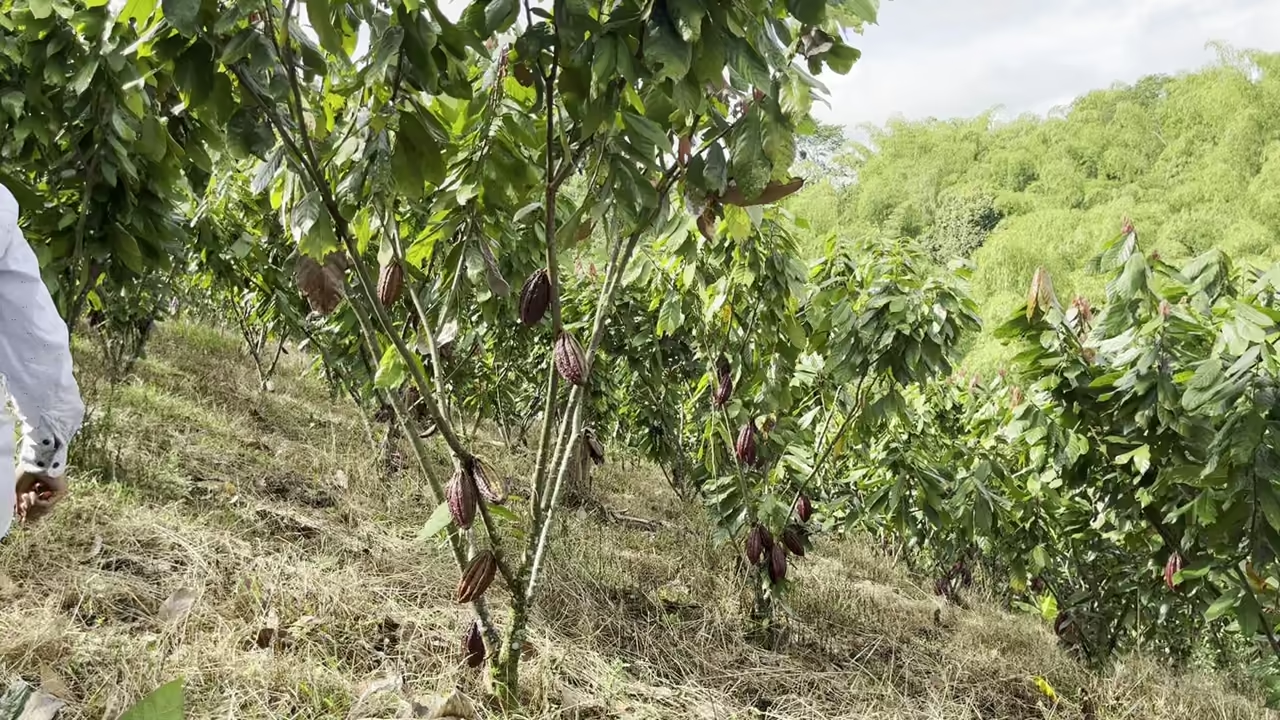
The full lot data, from cut test to sensory evaluation, is on the Macondo origin page.
Terroir, genetics and post-harvest: what actually shapes flavor
It is tempting to read a region name the way you read a wine label. With cacao, be more careful.
Genetics comes first. The clone determines which flavor precursors a bean can carry. A fine-flavor Trinitario and CCN 51 grown side by side will not taste alike, whatever the soil.
Post-harvest comes a close second, and often first. Colombian researchers describe fermentation as the single most critical step for cacao quality. Fermentation builds the precursors that roasting turns into flavor and reduces bitterness and astringency; drying that is too fast traps acids inside the bean. A fine clone fermented badly can taste worse than an ordinary clone fermented well. Our article on how cacao goes from harvest to chocolate walks through each step.
Terroir is real but harder to isolate. Altitude and temperature can change how quickly pods ripen and how a fermentation heap behaves. Bimodal rain in Santander means two harvests a year, while hotter, drier lowlands dry beans differently. Some sources go further and credit Colombia's diverse terroirs with enhancing aroma. That may be true, but separating region from clone and from post-harvest is difficult, and the effect is debated.
The practical rule: compare regions only with lots of known clones that were fermented and dried to a similar standard, with a cut test to prove it. Otherwise you are tasting the farm's process, not the place.
How to use regional information when you source
- Ask which clones are in the lot. The region narrows the likely clones, but it does not tell you which ones.
- Ask for the fermentation and drying protocol, in days and temperatures, not adjectives.
- Ask for the lot's cut test: percentage of well-fermented beans, moisture and bean index.
- Ask for the harvest window. In bimodal regions, the main and secondary harvests can differ.
Our guide on how to choose a cacao bean supplier covers the rest of the checklist.
Frequently asked questions
Where is cacao grown in Colombia?
Cacao is grown in 27 of Colombia's departments. The main producing areas are the Santander mountains, the Magdalena Medio valley, the Llanos foothills of Arauca, Casanare and Meta, the inter-Andean valleys of Tolima and Huila, Antioquia, and the Pacific and Amazon lowlands, including Nariño around Tumaco.
Which Colombian region produces the most cacao?
Santander. It produced 28,107 tonnes of the national 69,101 tonnes in 2021, about 41%, according to MinAgricultura and Fedecacao figures. Arauca was second, with 7,896 tonnes.
Does the region change the flavor of Colombian cacao?
Somewhat, but less than genetics and post-harvest. The clone sets which flavor precursors a bean carries, and fermentation and drying decide how many of them survive. Climate and soil can shift the result, but how much is still debated, so compare regions only with lots that were fermented and dried to a similar standard.
Is cacao grown in Quindío and the coffee region?
Yes, in the lower and warmer parts of the coffee region. SelvaCoa's Macondo lot comes from Finca Macondo in Vereda El Laurel, Quimbaya, Quindío, and is a blend of the Fedecacao clones FSV 41 and FEAR 5.
Which Colombian origins does SelvaCoa sell?
Macondo, from Quimbaya, Quindío, is in stock in the US. Canaán, from the Sierra Nevada de Santa Marta, is arriving soon, with a waitlist open for free samples. Huila and Meta are on a waitlist and are not for sale yet.
- MinAgricultura (2021). Cadena de cacao. Cifras Sectoriales. sioc.minagricultura.gov.co
- Fedecacao (2022). Economía Nacional. fedecacao.com.co
- Jaimes Suárez, Y.Y. et al. (2022). Modelo productivo para el cultivo de cacao (Theobroma cacao L.) en el departamento de Santander (2nd ed.). AGROSAVIA. doi:10.21930/agrosavia.model.7405538
- Rodriguez-Medina, C. et al. (2019). Cacao breeding in Colombia, past, present and future. Breeding Science, 69(3), 373–382. doi:10.1270/jsbbs.19011
- Báez Daza, E.Y. et al. (2022). Caracterización agronómica, fisicoquímica, sensorial y de metabolitos con actividad funcional de cacaos especiales cultivados bajo sistemas agroforestales en el departamento de Santander. AGROSAVIA. doi:10.21930/agrosavia.investigation.7405309
- Palacio Garrido, D. (2007). Caracterización (fingerprinting) de clones de Theobroma cacao L. de interés comercial de la Zona Cafetera Marginal Baja (ZCMB) utilizando marcadores tipo fAFLP. Universidad de los Andes.
- Nature Scientific Reports (2024). A revisited history of cacao domestication in pre-Columbian times revealed by archaeogenomic approaches. doi:10.1038/s41598-024-53010-6
- Finca Macondo technical data sheet (lot harvested October–November 2025).