The history of cacao in Colombia, from the Amazon to the bean-to-bar era
Colombian cacao origin goes back to the upper Amazon, where the species is most diverse. Since then the crop has been grown as Criollo, reshaped by Forastero and disease, rebuilt by national breeding, and rediscovered by bean-to-bar makers.

- Cacao is most genetically diverse in the upper Amazon, near the borders of Colombia, Ecuador and Peru. Researchers have also identified a Caquetá genetic cluster found in Colombian territory.
- The oldest confirmed evidence of people using cacao, about 5,300 years old, comes from Santa Ana-La Florida in southeastern Ecuador.
- Colonial Colombia grew Criollo. From around 1885, Forastero "pajarito" and disease pressure turned the national tree population into today's hybrid mix.
- Since 1999, selection on farmers' land has produced Colombia's registered clones, and the ICCO lists Colombia among fine-or-flavour cocoa exporters.
If you make chocolate from Colombian beans, you are working with a crop that has a longer history here than almost anywhere. Knowing that history helps you read a bean. It explains why a Colombian lot can carry Criollo-like delicacy and Trinitario vigour in the same box, and why clone names like FSV 41 or TCS 01 keep turning up on spec sheets.
This is a short history of cacao in Colombia, told for makers. Where the evidence is thin, we say so.
Where cacao comes from: the upper Amazon
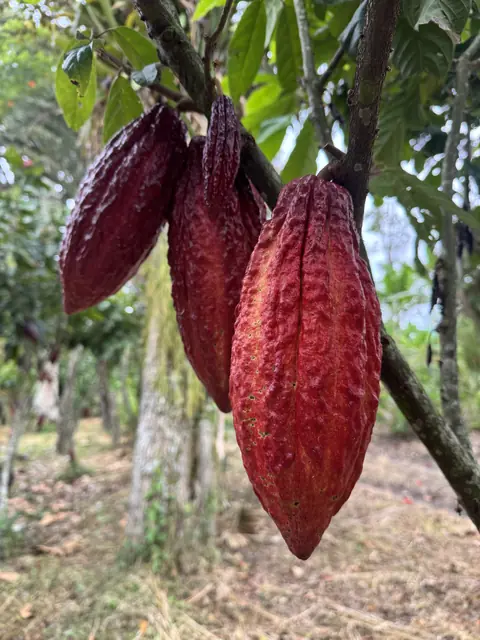
Theobroma cacao is native to tropical South America. The genus name, meaning "food of the gods", was given by Carl Linnaeus in 1753.
Molecular studies agree that the species is most diverse in the upper Amazon basin, around the frontiers of Colombia, Ecuador and Peru. For a long time cacao was sorted into three groups: Criollo, Forastero and Trinitario. In 2008 Motamayor and colleagues analysed a large set of samples and proposed ten genetic clusters instead: Amelonado, Contamana, Criollo, Curaray, Guiana, Iquitos, Marañon, Nacional, Nanay and Purús.
That framework is now the common language of cacao genetics. It is also a reminder that "Forastero" was never one thing. It was a bucket for most of the Amazon's diversity.
The Caquetá cluster
Colombian researchers working with the national germplasm collection have since identified a further genetic group, named Caquetá after the Amazon department it is associated with. Some authors now speak of eleven groups.
The Caquetá cluster matters for two reasons. It shows that Colombia is not only a grower of cacao but a reservoir of the crop's original diversity. And it is largely unexplored: AGROSAVIA reports that this wild material has not yet been brought into commercial breeding. In 2018 an expedition by AGROSAVIA and the Universidad de los Andes collected wild Theobroma and its close relative Herrania in Caquetá and Putumayo to widen the collection.
For a maker, the honest takeaway is modest. You will not find a "Caquetá cluster" bar on the market any time soon. But the genetics behind Colombian cacao run deeper than any one variety name.
The first cacao users were in South America
For most of the twentieth century, cacao's story began in Mesoamerica, with the Olmec, Maya and Aztec. Archaeology has moved that starting point south.
At Santa Ana-La Florida, in the Zamora-Chinchipe province of southeastern Ecuador, Zarrillo and colleagues found cacao starch grains, theobromine residues and ancient cacao DNA in vessels of the Mayo-Chinchipe culture. The evidence dates to about 5,300 years before present, the oldest confirmed evidence of cacao use and domestication anywhere.
A 2024 archaeogenomic study in Scientific Reports went further, analysing cacao DNA in pre-Columbian vessels from a range of sites. It found material from several genetic groups and signs of mixing between them, which suggests that people were moving and exchanging cacao long before Europeans arrived. Cacao travelled north from the Amazon-Andes interface, and the territory that is now Colombia sits squarely on that route.
Cacao in pre-Columbian Colombia
Here the record becomes patchier, and we would rather be careful than colourful. Colombian sector histories commonly name the Muisca, Quimbaya, Tairona and Zenú among the cultures that knew cacao. The Muisca highlands are too high and cold to grow it, so cacao there would have arrived through trade with lowland peoples.
Beyond that, detailed and well-sourced evidence of how each culture used cacao is limited. What the archaeogenomic work does support is the general picture: cacao was known, moved and selected across northern South America for thousands of years.
The colonial Criollo period
Spanish colonisers arrived on the Caribbean coast at the turn of the sixteenth century. The earliest documented cacao plantation in Colombia, according to the historian Patiño, was established in 1622 near Cali, in what is now Valle del Cauca.
Through the colonial period the cacao grown was mainly Criollo, the pale-seeded, delicately flavoured type Europeans prized. Patiño places this production in the warm inter-Andean valleys of the Cauca and Magdalena rivers and in the foothills of the Eastern Cordillera, in today's Santander. Santander is still Colombia's largest cacao department.
Pajarito, and the diseases that changed the tree
Criollo tastes wonderful and is fragile. Around 1885, Forastero-type cacao known locally as "pajarito" was introduced into Antioquia. It was more vigorous and more tolerant of disease, and it spread across the country, gradually displacing the old Criollo.
Disease drove the change. Moniliasis, caused by Moniliophthora roreri, has its earliest known record in Colombia, in Norte de Santander in 1817, where it was called "la mancha". Together with witches' broom and Phytophthora pod rot, it put heavy pressure on susceptible Criollo plantings.
The result is the Colombian cacao population makers buy from today: largely a Forastero-Trinitario hybrid mix, with Criollo ancestry running through it. That mix is why careful selection and good fermentation can coax such range out of Colombian beans.
Building a national collection, 1960 to 1991
In 1960 Colombia's first national cacao germplasm bank was set up at the Palmira research centre in Valle del Cauca. It was stocked with international selections: ICS (Imperial College Selection, from Trinidad), TSH, EET from Ecuador, UF from Central America, and IMC and PA from Peru. These became the foundation of the country's first formal breeding work.
From 1969 Colombian collections were added, under the codes ABC, EBC (from a botanical expedition to Caquetá) and CR (Criollo). In 1991 the materials were consolidated into the national germplasm bank at the La Suiza research centre in Rionegro, Santander, now AGROSAVIA's main cacao station.
Selections from that era are still found on Colombian farms today.
Selecting with farmers: SCC, TCS and the 2014 registrations
By the 1990s production was in decline, with ageing plantations and little technical support. The response that changed Colombian cacao was participatory selection: instead of breeding only on research stations, scientists looked for outstanding trees already growing on farms.
In 1999 Corpoica (renamed AGROSAVIA in 2018) began working with farmers in Santander, selecting trees for yield, disease resistance and quality. The first selections were coded SCC. From 2008 a larger program evaluated more than 255 genotypes in farmers' fields, and the best were coded TCS, for Theobroma Corpoica La Suiza. Fedecacao, the growers' federation, ran its own selection in Santander, Arauca and Antioquia.
2014 was the turning point. TCS 01 and TCS 06 were registered with the ICA, and in December Fedecacao registered eight clones: FEAR 5, FEC 2, FLE 2, FLE 3, FSA 12, FSA 13, FSV 41 and FTA 2. More followed, including TCS 13 and TCS 19 and Fedecacao's FSV 155 in 2017.
FSV 41 makes up half of Macondo. For the full catalogue, see our guide to Colombian cacao varieties and clones.
Cacao, coca and the peace agreement
From around 2000, government alternative-development programs promoted cacao as a legal crop for regions moving away from coca. It suited the land and climate of many of those areas, and it gave cacao a new political weight and more institutional investment.
The 2016 peace agreement between the Colombian government and the FARC included a national program for substituting illicit crops. Cacao has been one of the crops planted in former conflict territories such as Caquetá, Putumayo and Meta. Results have varied from place to place, and the work is ongoing.
The bean-to-bar era
Today the ICCO lists Colombia among the countries that export fine-or-flavour cocoa, classing 95% of its exports that way. For bean-to-bar makers, the interesting unit is no longer the country but the region, the clone and the farm.
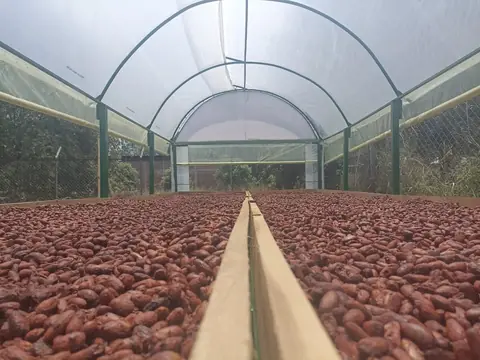
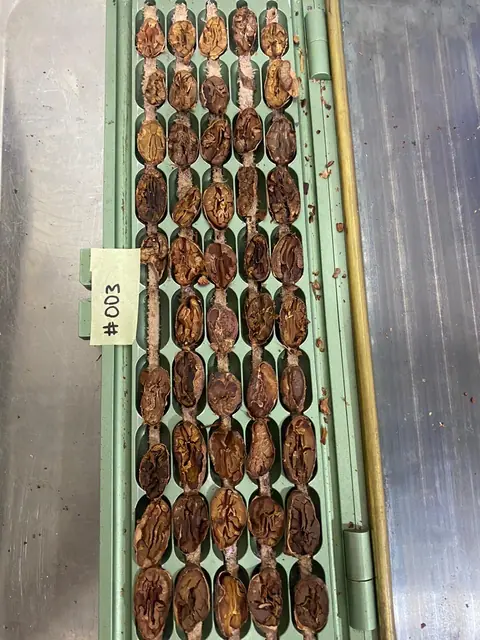
That demand has pushed attention down to the farm: defined lots, measured fermentation and drying, cut tests and sensory panels. The history above is why there is so much to work with. If you want to see how that plays out across the map, read our guide to Colombian cacao regions. To read a lot's quality for yourself, start with the cacao cut test, explained.
Timeline
- c. 5,300 BPCacao residues and DNA in Mayo-Chinchipe vessels at Santa Ana-La Florida, southeastern Ecuador: the oldest confirmed evidence of cacao use.
- 1622A cacao plantation near Cali, cited by Patiño as the first documented in Colombia.
- 1753Linnaeus names the genus Theobroma.
- 1817First known record of moniliasis, "la mancha", in Norte de Santander.
- c. 1885Forastero "pajarito" introduced into Antioquia; it gradually displaces Criollo.
- 1960First national cacao germplasm bank at Palmira, Valle del Cauca.
- 1969Colombian collections (ABC, EBC, CR) added.
- 1991Collections consolidated at La Suiza, Rionegro, Santander.
- 1999Corpoica begins participatory selection with farmers in Santander (SCC).
- 2008Motamayor and colleagues propose ten genetic clusters. In Colombia, the TCS program starts evaluating genotypes in farmers' fields.
- 2014TCS 01 and TCS 06 registered with the ICA; Fedecacao registers eight clones, including FSV 41.
- 2016Peace agreement with the FARC, including a program to substitute illicit crops.
- 2017TCS 13, TCS 19 and FSV 155 released.
- 2018Corpoica becomes AGROSAVIA; wild Theobroma collected in Caquetá and Putumayo.
Frequently asked questions
Is Colombia one of the places cacao comes from?
Colombia borders the upper Amazon, the region where Theobroma cacao shows its greatest genetic diversity, and researchers have identified a genetic group, Caquetá, found in Colombian territory. The oldest confirmed evidence of people using cacao, about 5,300 years old, comes from neighbouring southeastern Ecuador.
What is the Caquetá cacao genetic cluster?
It is a genetic group of cacao that Colombian researchers have proposed in addition to the ten clusters described by Motamayor and colleagues in 2008. It is associated with material from the Colombian Amazon, and it has not yet been used in commercial breeding.
Is Colombian cacao Criollo?
Mostly not, in the strict sense. Criollo dominated the colonial period, but from the late nineteenth century more vigorous Forastero material and disease pressure turned the national population into a Trinitario-type hybrid mix. Modern Colombian clones come from that mix and from introduced selections such as ICS.
Why is cacao linked to Colombia's peace process?
For more than two decades cacao has been promoted as an alternative to coca in rural regions, and the 2016 peace agreement created a national program for substituting illicit crops. Cacao has been one of the crops planted in those territories.
- Motamayor, J.C. et al. (2008). Geographic and genetic population differentiation of the Amazonian chocolate tree (Theobroma cacao L.). PLOS ONE, 3(10).
- Rodriguez-Medina, C. et al. (2019). Cacao breeding in Colombia, past, present and future. Breeding Science, 69(3), 373–382. doi:10.1270/jsbbs.19011
- Zarrillo, S. et al. (2018). The use and domestication of Theobroma cacao during the mid-Holocene in the upper Amazon. Nature Ecology & Evolution, 2, 1879–1888.
- A revisited history of cacao domestication in pre-Columbian times revealed by archaeogenomic approaches (2024). Scientific Reports. doi:10.1038/s41598-024-53010-6
- The history of cacao and its diseases in the Americas (2020). Phytopathology. doi:10.1094/PHYTO-05-20-0178-RVW
- Patiño, V.M. (2002). Historia y dispersión de los frutales nativos del neotrópico. CIAT, Cali.
- Fedecacao (2022). Ampliación del registro de materiales de Fedecacao para más regiones del país (ICA Resolution No. 67516, 2020).
- Báez Daza, E.Y. et al. (2022). Caracterización agronómica, fisicoquímica, sensorial y de metabolitos con actividad funcional de cacaos especiales cultivados bajo sistemas agroforestales en el departamento de Santander. AGROSAVIA. doi:10.21930/agrosavia.investigation.7405309
- International Cocoa Organization. International Cocoa Agreement, 2010, Annex C: fine or flavour cocoa exporting countries.
- Acuerdo Final para la Terminación del Conflicto y la Construcción de una Paz Estable y Duradera (2016), Point 4: Solution to the problem of illicit drugs.
- MinAgricultura (2021). Cadena de cacao: cifras sectoriales. sioc.minagricultura.gov.co
- Linnaeus, C. (1753). Species Plantarum.