Buying cacao beans wholesale: order sizes, prices and what to ask
Buying cacao beans wholesale is a ladder: a sample to taste, a trial to test, then boxes, pallets or containers as your production grows. Here is what each step is for, what really sets the price you pay, and the questions to ask before you commit to a volume.

- Wholesale cacao moves up a ladder: sample, trial, boxes or sacks, pallets, full containers. Climb it one step at a time, and only once the step below has told you something.
- A wholesale price reflects quality category, lot size, origin, testing, documentation, freight and who carries the import work. Two quotes per kilo are rarely for the same thing.
- Compare landed cost per kilo: the bean price plus every cost of getting the beans to your door, divided by the kilos that arrive.
- Before a larger order, ask whether you can buy the same lot again, and how much of it is left.
Searching for cacao beans wholesale turns up everything from 1 kg bags to commodity contracts measured in tonnes. For a maker, the useful question is not who sells cheapest. It is which order size fits where your production is today, and what that order will really cost by the time the beans are in your workshop or factory.
This guide is for every scale, from a one-person workshop roasting its first lot to an operation planning containers. It sits next to our checklist for choosing a cacao bean supplier, which covers who to trust. This one covers how much to buy, and how to read the price.
The ladder of order sizes
Each step answers a different question. Skipping one usually means paying for the answer later, in beans that do not suit your recipe or a volume you cannot store.
Sample: does this bean interest me?
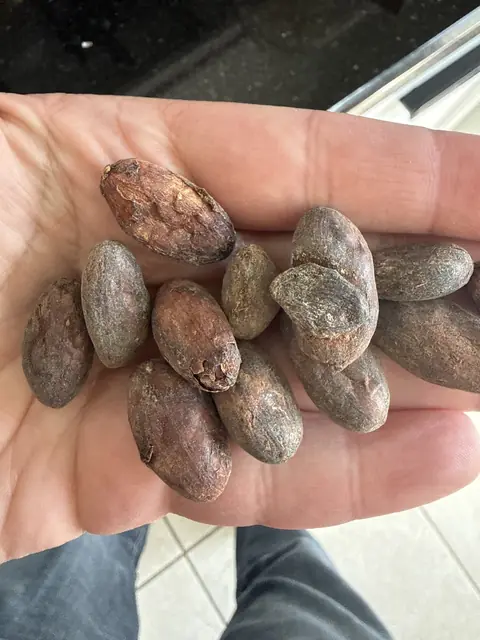
A sample is for the bench, not the line. It should be large enough for several cut tests and a small test roast, so you can taste the liquor next to a lot you already know. Ask whether it comes from the lot you would actually buy. A sample from another harvest is a sample of another bean.
Trial or production test: does it work in my process?
A trial is enough to run a real batch on your own roaster, winnower and melanger. This is where you find out your roast loss, how cleanly the shells come away, and how the bar tastes at your percentage.
Boxes or sacks: regular production
Once a bean has earned a place in your lineup, you buy it in trade units. Jute sacks are common in the cacao trade. Boxes with a hermetic liner are another option, and we ship ours in 25 kg boxes with a GrainPro bag inside, which helps keep the beans at their dried moisture and protects them from the air around them. Whatever the unit, ask its exact net weight, so your per-kilo maths is right.
Pallets: planned volume
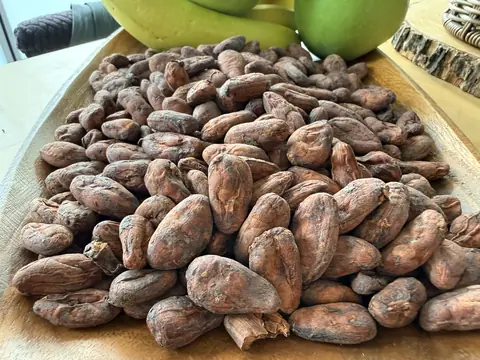
A pallet makes sense when you know your monthly use and have the dry, cool space to hold it. Price breaks often appear at this level, but a pallet of beans you cannot store well is not a saving.
Full containers: buying at origin
At container scale the beans usually ship from the producing country, and the conversation changes. Trade terms, lead times, payment schedules and who handles the import become as important as the price. These orders are negotiated, not ordered from a price list.
Order size ladder
| Step | What it is for | What to check | SelvaCoa example |
|---|---|---|---|
| Sample | Cut test, test roast, liquor tasting | Same lot as the one for sale; lab report included | Free 1 kg, US shipping paid by us, one per company, for makers who roast from the bean |
| Trial | A full batch on your own equipment | Price, who pays freight, whether it is the same lot | 5 kg trial pack at $16/kg ($80) plus freight at cost, one per company |
| Boxes or sacks | Regular production | Net weight per unit, packaging, price breaks, lot remaining | 25 kg boxes with a hermetic GrainPro bag: $14/kg up to 200 kg, $13.25/kg over 200 kg |
| Pallets | Planned volume | Storage space, delivery access, payment terms | Boxes from our US warehouse, or direct from Colombia from 500 kg |
| Containers | Industrial production | Trade terms, lead time, who imports, documentation | From 500 kg up to full containers, direct from Colombia, on terms negotiated with each buyer |

What drives a wholesale cacao price
Two quotes per kilo are rarely for the same product. These are the main reasons they differ.
- Quality category. Bulk cocoa is a commodity priced against the futures market; fine-flavor cacao, a category the International Cocoa Organization (ICCO) recognizes as fine or flavour cocoa, is usually negotiated lot by lot. Our guide to fine-flavor vs bulk cacao explains the line between them.
- The work inside the lot. Genetics, careful fermentation, slow drying, sorting and grading all cost the grower time and yield. We break that down in why fine-flavor cacao costs more.
- Lot size and your volume. Per-kilo prices usually fall as volume rises, because handling, paperwork and testing are spread over more beans.
- Origin and supply. A small, well-documented lot from a named farm is scarcer than a regional blend, and priced accordingly.
- Testing and documentation. A cut test, a contaminant panel and traceability to a farm each cost money, and they are paid per lot.
- Freight and who imports. A price at origin and a price from a warehouse in your country are not comparable until you add the cost of moving and clearing the beans.
Landed cost: the number to compare
Landed cost per kilo is everything you pay to get the beans to your door, divided by the kilos that arrive. Our supplier checklist gives the formula. In practice, the lines that get missed are:
- Freight from origin or warehouse to your door, and whether it is charged at cost or with a margin.
- Insurance for the goods in transit.
- Import formalities. In the US, each shipment of imported food needs prior notice to FDA and a customs entry, usually filed by a licensed customs broker. The FSVP importer must also verify the foreign supplier under FDA's Foreign Supplier Verification Programs rule. Other countries have their own rules, so ask who handles them where you are.
- Duties and taxes that apply in your country, if any.
- Losses. Shell, defects and moisture change how many usable kilos you end up with. A cheaper lot with more defects can cost more per bar.
Trade terms decide who pays what
Larger orders shipped from origin are usually quoted on trade terms, often written as Incoterms rules published by the International Chamber of Commerce. Under FOB, the seller's responsibility ends once the goods are loaded on the vessel at the port of shipment, and you arrange and pay for the sea freight. Under CIF, the seller pays freight and insurance to your destination port, but you still handle import. Under DDP, the seller delivers with duties paid. The same per-kilo price means a very different landed cost under each, so always ask which term a quote is on.
An example with our prices
Our beans are already imported (FDA-registered, FSVP documented by the importer) and ship from a US warehouse. A buyer in the US needs no broker, customs entry or freight forwarder. Freight is charged at cost, with no markup, and quoted with the order. So for a US maker the landed cost has two lines:
- Four boxes (100 kg) at $14/kg: $1,400, plus freight at cost.
- Ten boxes (250 kg) at $13.25/kg: $3,312.50, plus freight at cost.
Divide each total by the kilos received and you have a number you can set against any other quote, once that quote also includes its freight and import costs. From 500 kg up to full containers, beans ship direct from Colombia, and the trade terms are worked out with each buyer.
What to ask before a wholesale order
Our ten-point supplier checklist covers the general questions. At wholesale volume, these are the ones that carry the most weight.
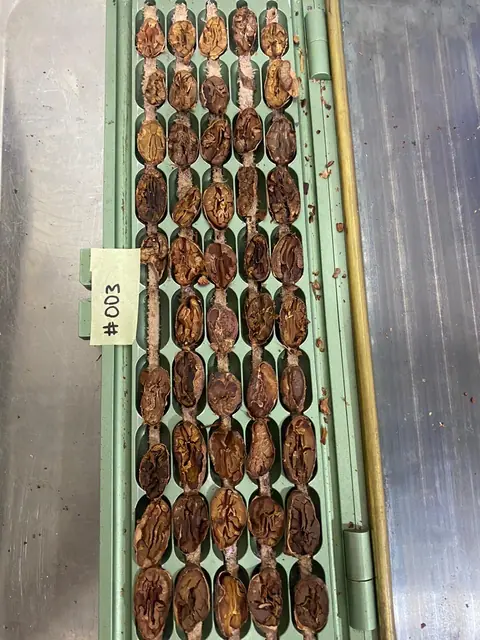
- Lot data for this lot. A cut test with the fermentation percentages and defects, moisture, and bean count or bean index, with a date and a report number, graded against a standard such as ISO 2451 or Colombia's NTC 1252. Our guide to the cacao cut test explains how to read them.
- The lab panel. Heavy metals such as cadmium and lead, mycotoxins, a pesticide residue screen and basic microbiology.
- Can I buy the same lot again? Ask how many kilos remain, whether the supplier can set some aside, and what comes next when the lot runs out. Consistency is what lets you keep a bar on the shelf.
- Minimums and price breaks. The smallest order, the volumes where the price steps down, and whether a trial size exists between sample and box.
- Sample and trial from the same lot. Otherwise you are testing one bean and buying another.
- Lead time. Where the beans are now: in a warehouse near you, or still at origin. Ask for a realistic window, not a best case.
- Documentation. What paperwork comes with the shipment, and who has handled food-safety and import requirements.
- Packaging and storage advice. How the beans are packed, how they have been stored since export, and the moisture at the last measurement.
When a wholesale order arrives
Check the delivery against the paperwork: count the units, weigh one or two, and note the lot number. Then run your own cut test on a handful of beans and compare it with the supplier's report. It takes minutes and it gives you a record if anything is wrong.
Storage is general practice rather than a fixed standard. Keep the beans sealed in their liner, somewhere cool and dry, off the floor and away from anything with a strong smell, because dry cacao picks up moisture from humid air and absorbs odors. Use the oldest stock first.
How SelvaCoa sells wholesale
We sell Colombian fine-flavor cacao beans to bean-to-bar makers worldwide, from a 1 kg sample to full containers. Today our lot in stock is Macondo, from Quindío, with 1,000 kg in US stock and lab reports with every sample. Canaán, from the Sierra Nevada de Santa Marta, is arriving soon, with a waitlist for a free 1 kg sample. In North America, boxes ship from our US warehouse. Elsewhere, tell us where you are and we will work out the best way to get beans to you.
Frequently asked questions
What is the minimum order for wholesale cacao beans?
It depends on the supplier and on where the beans are. Beans already imported and held in a warehouse are often sold by the box or sack, while beans shipped from origin usually move by the pallet or the container. At SelvaCoa the smallest regular order is one 25 kg box, with a 5 kg trial pack for a first production test.
How much do cacao beans cost wholesale?
There is no single wholesale price. Fine-flavor beans are usually priced lot by lot, and the figure moves with quality, lot size, origin, documentation and who carries freight and import costs. Compare landed cost per kilo rather than list price. Our own prices are public: 14 dollars per kilo in 25 kg boxes up to 200 kg, and 13.25 dollars per kilo over 200 kg, with freight at cost.
Is it cheaper to import cacao beans directly from origin?
The price per kilo can be lower at origin, but if you import yourself you take on freight, insurance, customs entry, FDA prior notice and, in the US, the duty to verify your foreign supplier under the FSVP rule. Whether that is worth it depends on your volume and how much of that work you want to take on. Run the landed cost both ways before deciding.
How should I store a wholesale order of cacao beans?
Keep the beans sealed in their liner, somewhere cool and dry, off the floor and away from anything with a strong smell, because dry cacao absorbs moisture and odors. Use the oldest stock first, and check a handful of beans now and then for mould or insects.
Can I buy the same cacao lot again?
Only while that lot lasts. A defined lot comes from one harvest and one post-harvest process, so ask how many kilos remain before you build a bar around it, and ask what the supplier will offer when it runs out.
- International Cocoa Organization (ICCO). Fine or flavour cocoa, and the list of fine or flavour producing countries, International Cocoa Agreement, 2010, Annex C.
- US Food and Drug Administration. Foreign Supplier Verification Programs for Importers of Food for Humans and Animals, 21 CFR Part 1, Subpart L.
- US Food and Drug Administration. Prior Notice of Imported Food, 21 CFR Part 1, Subpart I.
- US Food and Drug Administration. Registration of Food Facilities, 21 CFR Part 1, Subpart H.
- International Chamber of Commerce. Incoterms 2020 rules.
- ISO 2451:2017, Cocoa beans: Specification and quality requirements. International Organization for Standardization.
- ICONTEC (2021). NTC 1252, Cacao en grano: Especificaciones y requisitos de calidad.